HIPAA-Compliant Revenue Cycle Management for Specialty Healthcare Providers

DENIAL MANAGEMENT & AR RECOVERY

Denial Management Services That Recover Revenue and Stop Repeat Denials

Our denial management services find why your claims are denied, overturn the ones worth fighting, and fix the root causes so the same denial never comes back.

For practices that want denied dollars recovered — not just claims resubmitted.

Aayur Corporate Image

THE REAL DENIAL PROBLEM

Why Denials Drain Revenue Even When Your Team Works Hard

Most practices do not have a denial problem. They have a denial visibility problem. Claims get denied, staff resubmit where they can, write off where they cannot, and the cycle repeats. Nobody sees the full pattern because nobody is aggregating the data across payers, reason codes, and providers simultaneously.

The result is that denial rates stay flat or worsen quarter over quarter despite constant effort. The team is working hard on the wrong layer of the problem. Denial visibility means knowing exactly which reason codes are driving volume, which payers are generating systematic denials, and which providers or service lines have coding or documentation patterns that payers are rejecting. Once that data is clear, the fixes are usually straightforward. Without it, every denied claim looks like an isolated event rather than a symptom of a fixable system failure.

DENIAL MANAGEMENT, DEFINED

What Is Denial Management in Medical Billing?

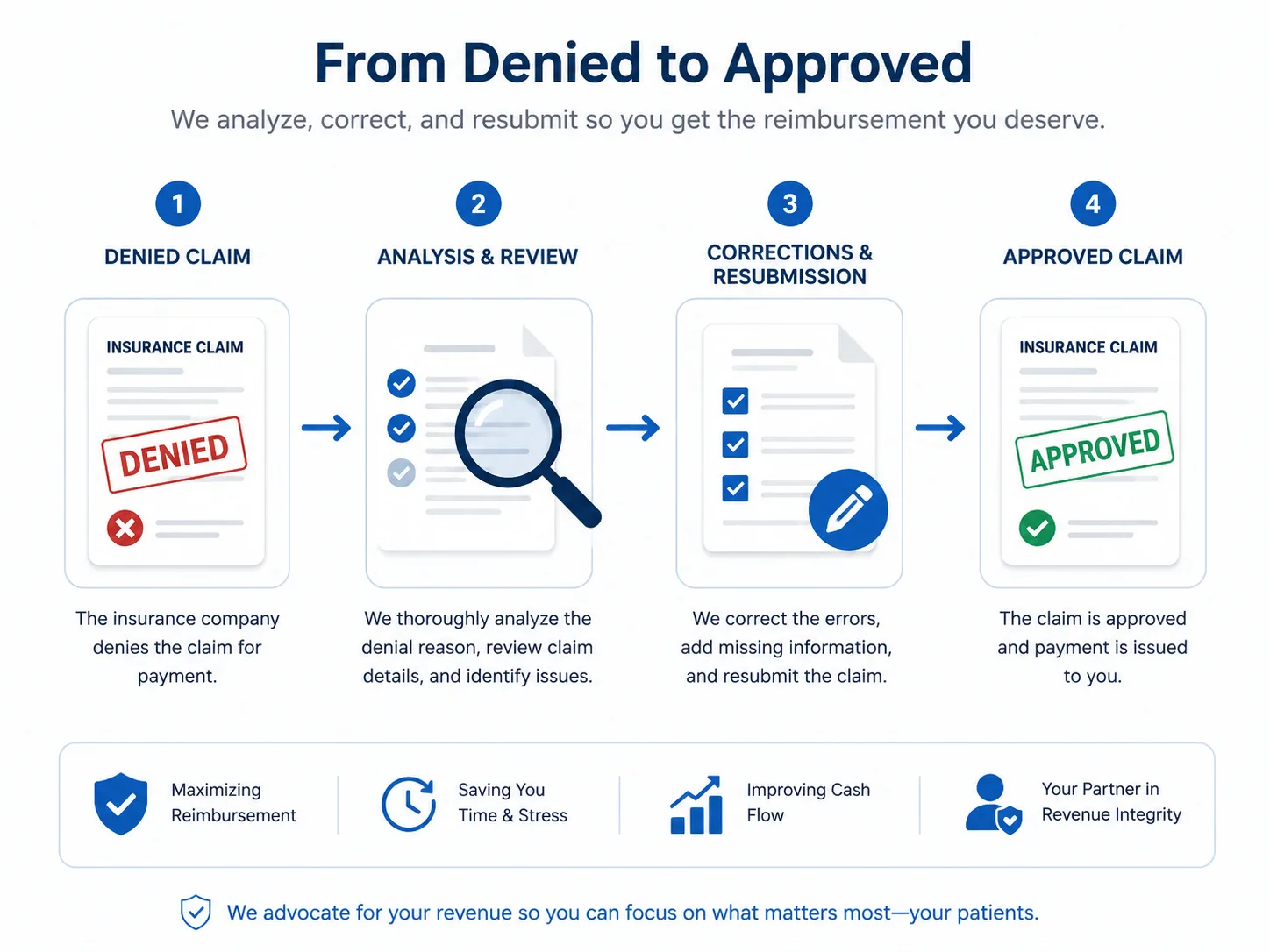
Denial management in medical billing is the systematic process of identifying why insurance claims are denied, correcting the underlying errors, appealing decisions where warranted, and implementing upstream fixes so the same denial class does not repeat. It covers the full lifecycle from initial denial receipt through final payment or write-off determination.

Effective denial management runs two tracks simultaneously. The first is recovery: working aged and current denied claims through appeals, corrections, and resubmission to extract revenue that has already been earned. The second is prevention: identifying the root cause of each denial category and fixing the intake, coding, authorization, or eligibility workflow that produced it. Most billing departments only run the first track. They rework individual claims, collect on some, and write off the rest while the same denial reasons generate new denials the following month.

Practices that treat denial management as a standalone appeals function typically achieve 60-70% net collection rates. Practices that run recovery and prevention as an integrated system regularly reach 95-98% net collection rates on the same claim volume, because the second track eliminates entire denial categories over time rather than fighting them one claim at a time.

Resubmitting claims is not denial management. A resubmitted claim with the same underlying error gets denied again at the same cost in staff time, with the same revenue outcome. What changes is the filing clock: each resubmission eats into the payer timely filing window, and eventually the claim ages out of recoverable status entirely.

True denial management requires identifying the specific reason code (CARC/RARC) for every denial, tracing it to the workflow failure that caused it, correcting both the claim and the upstream process, and tracking whether the fix held across the following month of claims. A denial that recurs at the same rate after correction was not actually corrected at the root level.

The practices with the lowest denial rates do not have unusually skilled appeals staff. They have unusually good denial data. When every denial is categorized by reason code, payer, provider, and service type, the patterns become visible within 30 days. The top five denial categories almost always account for 70-80% of total denial volume. Fixing those five upstream is more valuable than any amount of downstream appeals work.


Medical billing denial management workflow illustration

THE AAYUR DENIAL MANAGEMENT APPROACH

Recovery and Prevention, Run as One System

Denied revenue does not come back on its own, and prevention without recovery leaves money on the table. We run both tracks in parallel from day one. Recovery starts immediately on your aged AR while prevention work begins on current claims. Most practices see measurable improvement within 30-60 days as recovery cash hits and denial rates on new claims begin declining.

The financial math is straightforward: a practice billing $150,000 per month with a 12% denial rate is generating $18,000 per month in denied claims. If 60% of those are recoverable and we achieve an 80% recovery rate, that is $8,640 per month in additional collections before prevention improvements reduce the denial rate itself. When denial rates fall from 12% to 5%, the ongoing gain is $10,500 per month on the same billing volume. Both outcomes compound over time. A one-time AR recovery is valuable. A sustained denial rate reduction is transformational.

Denial Triage

Appeals & Recovery

Root-Cause Prevention

AR Recovery

Denial Categories We Work Every Day

We manage the full spectrum of denial reasons across commercial payers, Medicare, and Medicaid:

Front-End Denial

Coding & Clinical Denials

Administrative Denials

Payment Denials & Underpayments

Denial categories and resolution overview for medical billing

Measured Outcome

Typical Results After 90 Days of Denial Management

of recoverable aged AR collected in the first 90 days
60–8 0 %
target denial rate after root-cause fixes
< 0 %
appeal overturn rate vs. typical in-house teams
0 ×
from denial received to categorized and queued
0 hrs

In-House Denial Management vs. Outsourcing to Aayur Solutions

In-House TeamAayur Solutions
Denial categorizationWhen staff have timeWithin 24 hours, every denial
Appeals expertiseGeneralist billersPayer-specific appeal specialists
Root-cause analysisRarely trackedMonthly pattern reports, standard
Aged ARAges past deadlinesWorked in parallel from day one
CostFixed salaries + turnover riskPercentage of net collections only
Filing deadlinesMissed under backlogDeadline-tracked, zero-miss workflow
Aayur Support Icon

COMPLIANCE & TRUST

Appeals That Hold Up Under Payer Scrutiny

Aggressive appeals without documentation discipline invite audits. Ours are built to withstand them.

HOW WE WORK

A Simple Engagement Model Practices Trust

Designed to stabilize revenue first then improve it systematically without disrupting operations or compliance discipline

process arrow 1 1
1_icon 101

Denial Audit

We analyze your last 6–12 months of denials and aged AR. You see exactly what's recoverable before committing.

process arrow 1 1
3_icon02

Recovery Sprint

Recoverable claims and appeals are worked immediately - cash starts moving in weeks, not quarters.

process arrow 1 1
4_icon03

Root-Cause Fixes

Pattern reports drive front-end corrections with your team: eligibility, auth, coding.

Untitled 104

Ongoing Prevention

Monthly denial-rate tracking, payer trend alerts, and continuous workflow tuning.

OPERATIONAL ASSURANCE

Built for Continuity - Not Just a One-Time Cleanup

Built-in coverage & continuity

Clear escalation & communication

Flexible operational support

Transition & data support

Frequently Asked Questions

What are denial management services?

Denial management services are outsourced programs that identify why a practice’s insurance claims are denied, appeal the denials worth pursuing, correct the underlying errors, and implement process changes to prevent the same denial types from recurring. They typically include initial AR triage, ongoing denial tracking, payer-specific appeal preparation, root-cause analysis, and monthly reporting on denial trends by reason code and payer.

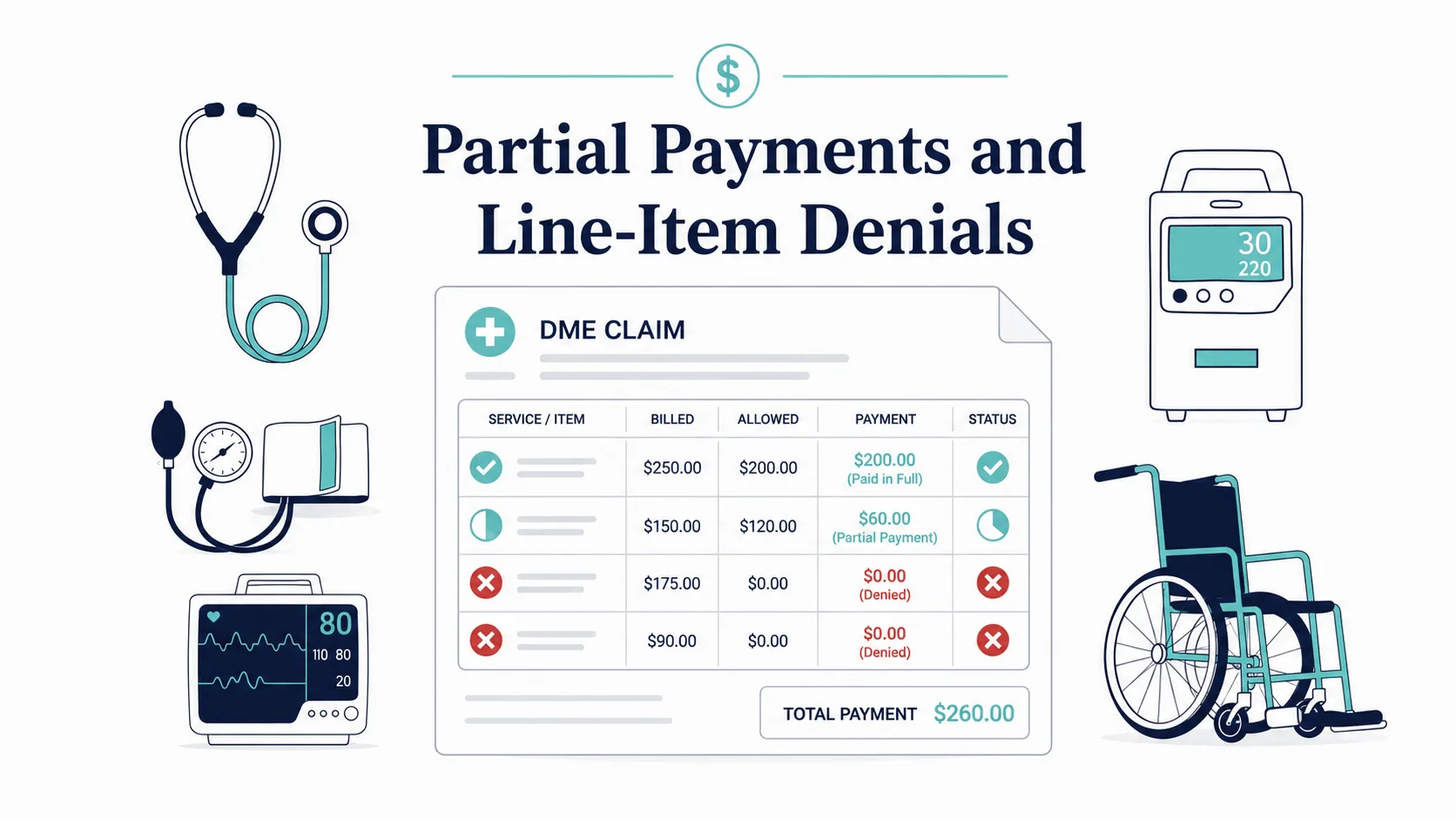
Full-service denial management also covers underpayment identification — verifying that claims paid by payers were reimbursed at the correct contracted rate, not just that they were paid at all. Studies suggest 7–11% of processed claims contain underpayments that practices never identify or pursue. A complete denial management program catches both outright denials and contractual shortfalls.

Industry benchmarks put a good claim denial rate below 5% of submitted claims. The U.S. average now runs 10–12% and has risen steadily since 2020 as payer prior authorization requirements expanded and documentation standards tightened. Practices in high-complexity specialties — pain management, behavioral health, DME — commonly see denial rates of 15–20% before targeted intervention.

First-pass denial rate (claims denied on initial submission) is the more actionable metric than overall denial rate, because it isolates front-end process failures from appeal outcomes. A first-pass denial rate above 8% indicates intake, eligibility, or coding problems that need to be fixed before claims leave the practice. A first-pass rate below 5% with a high overall denial rate usually points to payer behavior patterns that require appeals escalation rather than internal process changes.

Studies consistently show practices never rework up to 60% of denied claims, and each reworked claim costs $25–$118 in staff time — before it pays anything. That cost includes identifying the denial reason, pulling supporting documentation, drafting the appeal or correction, re-submitting, and tracking the outcome. For a practice with 500 claims per month and a 12% denial rate, that is 60 denied claims generating up to $7,080 in administrative cost per month, on top of the lost revenue from claims that are written off.

The hidden cost is opportunity cost: every hour a billing staff member spends reworking a denied claim is an hour not spent on eligibility verification or charge review that would prevent the next denial. The fully loaded cost of denial management — including staff time, write-offs, and appeal overhead — routinely exceeds the cost of outsourcing the function to a team that runs it at scale.

A rejected claim never enters the payer’s adjudication system — it fails front-end edits and is returned to the biller with an error code before any coverage determination is made. Common rejection reasons are invalid NPI, missing required fields, incorrect payer ID, or formatting errors. Rejections can be corrected and resubmitted quickly and do not count against timely filing in most cases.

A denied claim has been received and adjudicated by the payer, which issued a coverage determination: the service was not covered, was not medically necessary, lacked authorization, or fell outside policy parameters. Denied claims are subject to timely filing on appeal and require a formal appeals process with supporting clinical documentation. The distinction matters because the correction path and deadline risk are fundamentally different. Many practices conflate the two, which leads to missed appeal windows when a denial is treated as a simple resubmission.

Often, yes. Recovery depends on each payer’s timely filing and appeal deadlines — typically 90 days to 12 months from the date of denial for first-level appeals, with additional levels (redetermination, reconsideration, ALJ hearing for Medicare) extending the window further. Before committing to AR recovery work, we audit your aging AR and provide a recoverable estimate by payer and reason code so you know what is worth pursuing before work begins.

Claims older than 12 months are frequently still recoverable if they were denied rather than just unpaid — particularly under Medicare, where ALJ hearings have no timely filing limit once the appeal chain is entered. Commercial payer timely filing limits on appeals are typically shorter and stricter, which is why AR recovery should begin within 90 days of denial rather than at the 180-day aging mark where most practices notice the problem.

Yes. We prepare payer-specific appeal letters with supporting clinical documentation, file within deadlines, track every appeal level — from redetermination through Administrative Law Judge review where justified — and report outcomes monthly.

Every denial is categorized by reason code and tracked by payer, provider, and department. Monthly pattern reports identify the front-end causes — eligibility verification gaps, missing prior authorizations, coding errors — and we fix those workflows with your team so the same denials stop recurring.

A percentage of net collections — no flat fees, no per-claim charges, no charge on claims we don’t recover. The 45-day risk-free evaluation lets you see recovery results before committing long-term.