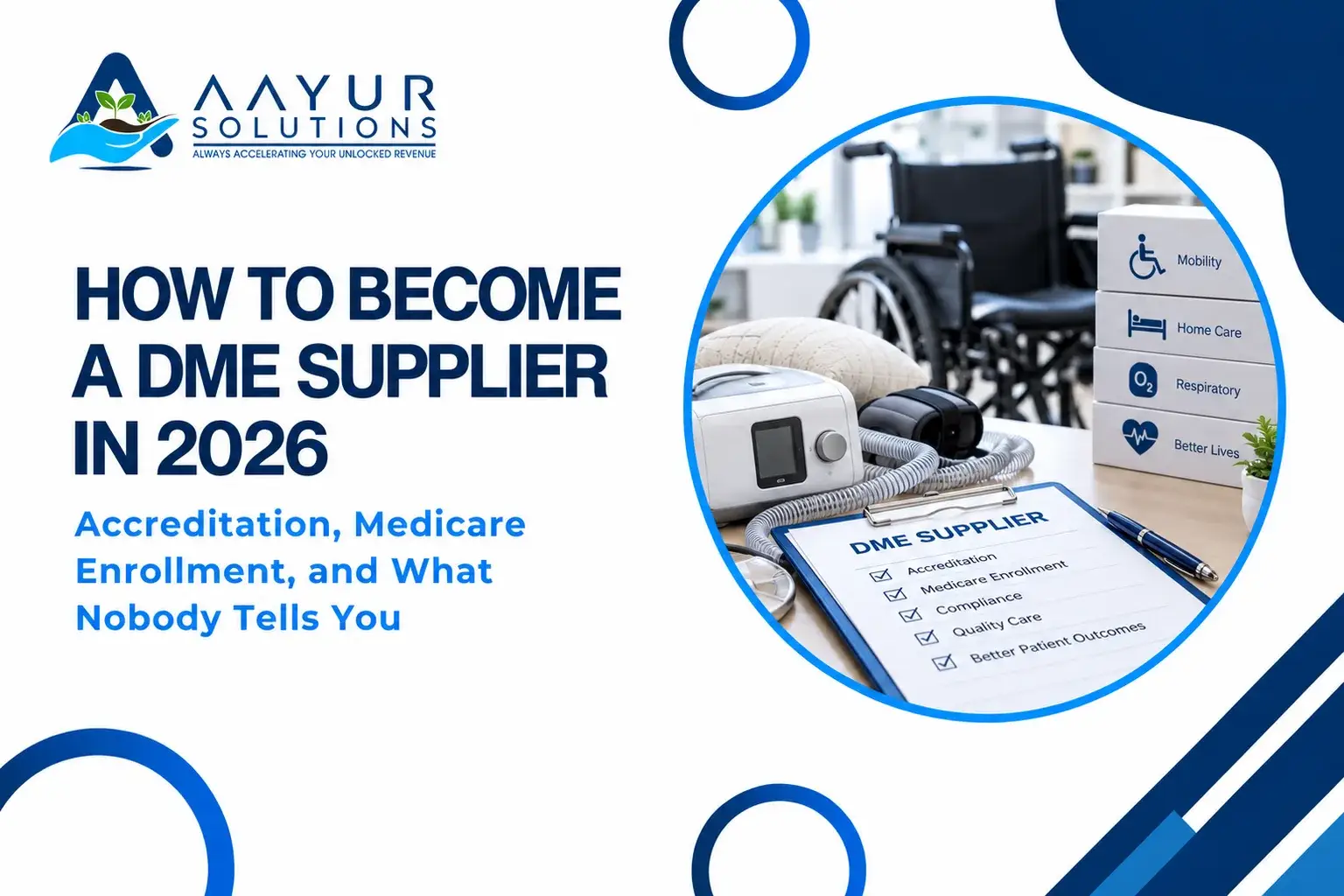
Most guides on how to become a DME supplier are either a CMS PDF that reads like a legal brief or a consultant’s website designed to sell you a $5,000 setup package. This guide is neither.
It covers the exact process (in the order you actually have to follow it) with current 2026 costs, all five CMS-approved accreditation bodies, the $50,000 surety bond requirement that catches nearly every new applicant off guard, state-by-state licensing rules, and the billing infrastructure you need ready before your first claim goes out.
The honest timeline is 5–9 months. Plan accordingly.
What Is a DMEPOS Supplier?
DMEPOS stands for Durable Medical Equipment, Prosthetics, Orthotics, and Supplies. A DMEPOS supplier is any business that provides these items to Medicare or Medicaid beneficiaries and bills those programs for reimbursement.
The category is broader than most people expect. It includes:
- Home oxygen equipment and concentrators
- Power wheelchairs, manual wheelchairs, and mobility scooters
- CPAP and BiPAP machines for sleep apnea treatment
- Hospital beds, patient lifts, and pressure-relief mattresses
- Prosthetic limbs and custom orthotic devices
- Diabetic supplies: test strips, lancets, continuous glucose monitors
- Enteral and parenteral nutrition equipment
- Nebulizers and respiratory therapy equipment
- Compression garments (specific classifications)
- Hundreds of other products billed under HCPCS Level II codes
Each product category has its own coverage rules, HCPCS codes, Local Coverage Determinations (LCDs), and prior authorization requirements. What you plan to supply determines which CMS supplier standards apply most directly to your operation, and which billing rules you need to master before your first claim.
Who Can Become a DME Supplier?
There is no clinical license requirement to become a DMEPOS supplier. Any business entity (LLC, corporation, or sole proprietorship) can enroll. CMS cares about whether you meet the supplier standards, maintain a compliant physical location, hold the required accreditation, and comply with all enrollment requirements.
Pharmacies, physician practices, home health agencies, and standalone DME businesses can all become DMEPOS suppliers through the same process. Certain clinical provider types (physicians, pharmacies) have limited surety bond exemptions, covered in Step 4.
The 6 Steps to Becoming a DME Supplier (Overview)
Here is the full process in the order you must complete each step:
- Obtain your NPI (National Provider Identifier)
- Meet all CMS DMEPOS Supplier Standards (42 CFR 424.57(c))
- Get accredited through a CMS-approved accreditation body
- Obtain your $50,000 DMEPOS surety bond
- Complete and submit Form CMS-855S through PECOS
- Complete state licensing requirements for your state of operation
Steps 1, 3, and 4 can run in parallel once you understand what each requires. Step 5 cannot be approved by CMS without Steps 3 and 4 completed and documented.
Step 1: Get Your NPI
Apply for a Type 2 NPI (for organizations) through the National Plan and Provider Enumeration System at nppes.cms.hhs.gov. The application is free and processing takes 1–2 weeks.
If you are a sole proprietor billing under your own name, you may use a Type 1 NPI. Most DME businesses should apply for a Type 2 organizational NPI.
If you plan to operate from multiple locations or moder different business structures, each location may require a separate NPI. Get this right before you do anything else: changing NPI information mid-enrollment causes processing delays that can set your timeline back by weeks.
You will need your NPI number on the CMS-855S application, on all Medicare claims, and throughout your relationship with your Medicare Administrative Contractor (MAC).
Step 2: Understand the CMS DMEPOS Supplier Standards
This is where most new suppliers run into problems, not because the standards are impossible to meet, but because they do not read them before spending money on inventory, leases, and staff.
CMS requires every DMEPOS supplier to meet the requirements set out in 42 CFR 424.57(c) as a condition of obtaining and maintaining Medicare billing privileges. The regulation has more than 20 specific requirements. The 10 most critical for new suppliers:
1. Comply With All Federal and State Laws
You must hold all required licenses, permits, and comply with all regulations in every jurisdiction where you operate. This includes business licenses, sales tax permits, professional licenses for clinical staff, and any state-specific medical device or pharmacy regulations.
2. Maintain a Physical Location in the United States
Your location must be in one of the 50 states, DC, Puerto Rico, the USVI, Guam, American Samoa, or the Northern Mariana Islands. A P.O. box, mail-forwarding address, virtual office, or home address does not qualify.
3. Have an Operational Physical Facility
Your facility must have: a visible business sign that can be seen from outside the building, adequate storage space for business records (delivery documentation, maintenance logs, beneficiary communications), space for serving beneficiaries in person, and regular business hours (minimum 30 hours per week) accessible to the public. CMS, the National Supplier Clearinghouse (NSC), and your MAC can and do conduct unannounced site visits.
4. Permit On-Site Inspections
You must allow CMS, the NSC, or their authorized agents to conduct on-site inspections at any time to verify compliance with supplier standards. Refusing or obstructing an inspection is grounds for immediate revocation of billing privileges.
5. Maintain a Business Telephone
A primary business phone (landline, cellular, or VoIP) must be listed under your business name, either locally or via a toll-free number accessible to beneficiaries. It must be answered during all posted business hours. An answering service may satisfy this in limited circumstances, but the expectation is direct access during business hours.
6. Carry Liability Insurance
A comprehensive general liability policy of at least $300,000 per occurrence is required, covering your business premises, all customers, and all employees. Your accreditation body will verify this during the survey process. Most suppliers carry $1,000,000 per occurrence in practice; $300,000 is the floor, not the recommendation.
7. Honor Beneficiary Protections
You must advise Medicare beneficiaries of their purchase versus rental options for capped rental equipment at the time of delivery, honor all warranty obligations on every item you supply, and provide written disclosure of your supplier standards to every beneficiary you serve, documented in your delivery records.
8. Have an NPI and Complete All Enrollment Disclosures
Your NPI must appear on all Medicare claims. Your CMS-855S application must include full disclosure of all ownership (anyone with 5% or greater interest), managing employees, and anyone with a controlling interest in the business. Incomplete ownership disclosure is the most common reason CMS returns applications for correction.
9. Make No False or Misleading Statements
Any misrepresentation of material fact on your enrollment application (ownership information, physical location, accreditation status) is grounds for denial, revocation, and potential exclusion from all federal healthcare programs.
10. Report Changes Within 30 Days
Any change in ownership, business location, business structure, authorized officials, or other enrollment information must be reported to your MAC within 30 days. Failure to report is one of the most common reasons enrolled suppliers face retrospective denial of claims: CMS can recoup payments made during a period where your enrollment information was inaccurate.
Read the full regulation at govinfo.gov before you sign a lease or place your first inventory order. Meeting these standards in a survey is different from operating a business that actually meets them every day.
Step 3: Get Accredited (All 5 CMS-Approved Bodies and What They Cost)
Medicare requires all DMEPOS suppliers to hold accreditation from a CMS-approved accreditation organization before submitting a single claim. There are currently five CMS-deemed accrediting organizations for DMEPOS. Most guides only mention two. Here is the full comparison:
| Accreditation Body | Focus | Initial Cost (2026) | Annual Cost | Best For |
|---|---|---|---|---|
| ACHC (Accreditation Commission for Health Care) | DMEPOS, HME | $4,200–$5,500 | $2,500–$3,500 | Most common for DME suppliers, faster turnaround |
| BOC (Board of Certification/Accreditation) | DMEPOS, orthotics, prosthetics | $4,000–$5,000 | $2,000–$3,000 | Suppliers with strong O&P product mix |
| CHAP (Community Health Accreditation Program) | DMEPOS, home health | $4,500–$6,000 | $2,500–$4,000 | Suppliers also providing home health services |
| HQAA (Healthcare Quality Association on Accreditation) | DMEPOS-only | $3,500–$4,500 | $2,000–$3,000 | DME-specialized, often most affordable option |
| TJC (The Joint Commission) | DMEPOS, multi-setting | $5,000–$8,000 | $3,500–$5,000 | Larger operations, hospital-affiliated suppliers |
Cost ranges vary by supplier size, number of locations, and product categories. All accreditation fees are tax-deductible business expenses. Check each body’s published fee schedule before selecting, as rates can change annually.
How the Accreditation Process Works
After you apply to your chosen accreditation body, they will review your policies and procedures against CMS supplier standards and their own accreditation criteria. This includes a documentation review and an on-site survey of your physical location.
During the survey, the accreditor will verify: your business sign is visible from outside, storage space meets requirements, your complaint protocol exists in writing, staff are appropriately trained, your liability insurance is current, and your delivery documentation process is clearly defined and operational.
Deficiencies found during the survey result in a corrective action period (typically 30–90 days) before re-survey or conditional accreditation is issued.
What You Need Ready for the Accreditation Survey
- Written policies covering patient rights, equipment maintenance, infection control, emergency procedures, and complaint resolution
- Proof of liability insurance ($300,000+ per occurrence)
- Evidence of physical location: lease or deed, facility photos, signage photos
- Staff qualification documentation (training records, any required certifications)
- Your delivery documentation process, written and operational
- Written beneficiary disclosure of supplier standards
- Inventory documentation or supplier agreements
Timeline: Plan for 60–120 days from application to accreditation certificate, assuming no major deficiencies at the survey.
Strategy note: You can submit Form CMS-855S while your accreditation is in progress. CMS will not issue your PTAN (billing number) until your accreditation certificate is on file, but submitting the enrollment application simultaneously saves 2–3 months of waiting time.
Step 4: The DMEPOS Surety Bond ($50,000 Requirement, Costs, and Exemptions)
Under 42 CFR 424.57(d), every DMEPOS supplier billing Medicare must obtain and maintain a surety bond of at least $50,000 per enrolled location. This requirement surprises nearly every new applicant.
A surety bond is not insurance for your business. It is a financial guarantee to the federal government that you will comply with Medicare requirements and repay any overpayments CMS determines you owe. If you cannot repay and your enrollment is revoked, the bonding company covers up to the bond face value.
Cost
Annual premiums for a $50,000 DMEPOS surety bond typically run 1–3% of the face amount, meaning $500–$1,500 per year for most suppliers, depending on your personal and business credit score. Suppliers with strong credit pay closer to 1%. Suppliers with thin credit histories or prior adverse actions pay closer to 3%.
Multiple Locations
You need a $50,000 bond per enrolled Medicare location. If you open three locations, you need $150,000 in total surety bond coverage. Budget for this before you scale.
The Bond Must Be Continuous
There can be no lapse in coverage. If your bonding company cancels the bond for any reason, you have 30 days to replace it or Medicare will revoke your billing privileges. Set up auto-renewal at the time you purchase the bond; do not manage this manually.
Elevated Bond Requirement
Under 42 CFR 424.57(d)(3), if you have had a prior Medicare revocation or certain specified adverse actions, CMS can require an elevated bond, up to $100,000 per location. This applies to the business entity and to individuals with ownership or managing control of the entity.
Who Is Exempt From the Surety Bond
- Physicians, nurse practitioners, physician assistants, and clinical nurse specialists: only when billing for DME they furnish directly to their own patients as part of their professional service
- State-licensed pharmacies: for limited DME categories only (diabetic supplies, ostomy supplies, enteral/parenteral nutrition)
- Physical and occupational therapists under specific CMS-defined conditions
- Government-owned suppliers: Veterans Affairs, Indian Health Service, federal hospitals
If you are a standalone DME business, you are not exempt. Budget for the surety bond before you budget for inventory.
Step 5: Complete Form CMS-855S (The Medicare Enrollment Application)
Form CMS-855S is the Medicare enrollment application for DMEPOS suppliers. Submit it through PECOS (Provider Enrollment, Chain, and Ownership System) at pecos.cms.hhs.gov. A paper version can be mailed to your MAC, but the online PECOS submission is faster and the preferred method.
Application fee: $330 as of 2026, adjusted annually by CMS. Non-refundable. Paid online via PECOS or by check made out to your MAC.
What You Need Before You Start the Application
- Your NPI (Type 2 for organizations)
- Accreditation certificate or documentation showing accreditation is in progress
- Surety bond documentation: bonding company name, bond number, face amount, effective date
- Comprehensive liability insurance certificate ($300,000+ per occurrence)
- Business structure and ownership documentation: all individuals with 5%+ ownership, including Social Security numbers and background information
- Physical facility information: address, lease or ownership documentation, facility photos showing signage
- Authorized official information: the person legally authorized to sign on behalf of the business entity
- Banking information for Electronic Funds Transfer (EFT): required before Medicare can disburse payments
- Business license and IRS EIN verification
The CMS-855S Enrollment Process, Step by Step
- Gather all documentation above before starting. Incomplete applications are returned, restarting your processing clock
- Create a PECOS account or log in at pecos.cms.hhs.gov
- Complete all sections of the online CMS-855S; do not leave required fields blank
- Upload all supporting documentation as PDF attachments
- Pay the $330 application fee
- Submit the application and note your tracking number
- Monitor your application status in PECOS. CMS will contact you if additional documentation is required (called an Additional Development Request, or ADR)
- Respond to any ADR within the timeframe specified, since delays on your end restart the processing clock
- Receive your PTAN (Provider Transaction Access Number): the 10-digit Medicare DMEPOS supplier number that allows you to bill
Processing time: CMS targets 60 days for a complete, deficiency-free application. Real-world timelines frequently run 90–120 days, particularly in high-fraud states (Florida, Texas, California, Michigan, New York) and during periods of high application volume. Once you have your PTAN, you are an active Medicare-enrolled DMEPOS supplier.
Step 6: State Licensing Requirements (TX, CA, FL, NY)
Federal Medicare enrollment via CMS-855S is separate from state-level requirements. Most states do not have a dedicated DME supplier license, but all of them require standard business registration, and several have additional requirements depending on your product categories.
Texas
No DME-specific state license required. You need a Texas Secretary of State business registration, a Texas Sales and Use Tax permit if you sell equipment directly, and applicable city/county business licenses. Pharmacy-based DME suppliers must comply with Texas State Board of Pharmacy regulations.
California
No general DME supplier license at the state level. However, businesses selling certain medical devices in California may need to register under the California Medical Device Safety Act (Sherman Food, Drug, and Cosmetic Law) if they manufacture or resell devices in the state. The CA Department of Public Health has regulatory authority over specific DME categories. Medi-Cal (California Medicaid) enrollment has its own separate process and requirements distinct from Medicare enrollment.
Florida
No DME-specific state license for most suppliers, but Florida carries heightened scrutiny due to its history as a high-fraud DME state. The Florida Agency for Health Care Administration (AHCA) oversees all healthcare-related business operations in the state. Pharmacy-based DME must comply with Florida Board of Pharmacy regulations. Expect closer review from your MAC (CGS Administrators covers Florida) both at enrollment and post-enrollment.
New York
No specific DME supplier license at the state level. Required: NY Department of State business registration and NY Department of Taxation and Finance registration. New York Medicaid (eMedNY) has its own separate DME supplier enrollment process. New York City has additional Department of Consumer Affairs licensing requirements for some categories of medical equipment sales at the local level.
The Rule That Applies Everywhere
Every state requires standard business registration, a federal EIN, sales tax permit where applicable, and professional licenses for any clinical staff you employ. State licensing rarely affects your ability to bill Medicare directly, but operating without required state business registration puts your entire enrollment at risk if CMS or a state agency flags the gap.
The Real DME Supplier Timeline (Not the Consultant Version)
Most consultants advertise a 3-month timeline. The honest range, for a supplier who starts prepared and encounters no significant setbacks, is 5–9 months from first step to first paid claim.
| Phase | Estimated Time | Notes |
|---|---|---|
| NPI application | 1–2 weeks | Free, straightforward: do this first |
| Policy development and accreditation preparation | 6–10 weeks | Most time-consuming phase for new suppliers |
| Accreditation survey and certificate issued | 4–8 weeks | Depends on surveyor availability and deficiency findings |
| Surety bond procurement | 1–2 weeks | Can run in parallel with accreditation |
| State business registration | 1–3 weeks | Varies by state |
| CMS-855S submission and CMS processing | 8–16 weeks | The biggest variable, longer in high-fraud states |
| Total (no setbacks) | 5–9 months | Plan for the longer end if you are in FL, TX, CA, NY, or MI |
Common setbacks that add time: incomplete documentation at the accreditation survey (the most common delay), Additional Development Requests from CMS requiring more documents, NSC or MAC site visits prior to approval, state licensing issues in more regulated states, and ownership disclosure complications when business structures include silent partners or complex equity arrangements.
Understanding HCPCS Codes for DME Billing
DMEPOS products are billed using HCPCS Level II codes, a standardized coding system for items and services not covered by standard CPT codes. Every piece of equipment you supply to a Medicare beneficiary must be coded correctly before the claim is submitted.
Key HCPCS code ranges for DME suppliers:
- A codes: Medical and surgical supplies, including diabetic supplies and wound care
- E codes (E0100–E8002): Durable medical equipment, including wheelchairs, hospital beds, oxygen, and CPAP
- K codes: Temporary codes for items under active CMS review or not yet permanently classified
- L codes: Orthotics and prosthetic devices
Each HCPCS code has a corresponding fee schedule amount: the maximum Medicare will reimburse for that item. The DMEPOS fee schedule is updated annually and published by CMS. Reimbursement rates differ between competitive bidding areas (where rates are set by contract) and non-competitive bidding areas (where the national fee schedule applies).
Before deciding what products to carry, look up the current DMEPOS fee schedule amounts for those specific codes. Some categories offer strong reimbursement in non-competitive bidding areas; others are compressed by competitive bidding to the point where margins are very thin for new suppliers.
Proof of Delivery: The #1 Reason New DME Suppliers Lose Money
You can complete every step of the enrollment process correctly and still lose a significant portion of your first-year revenue to one issue: proof of delivery documentation.
Medicare requires a signed delivery receipt for every item provided to a beneficiary before submitting a claim. The documentation must capture:
- Beneficiary name and Medicare number
- Date of delivery
- Detailed description of the item delivered (including serial number for certain equipment categories)
- Quantity delivered
- Beneficiary or authorized representative signature with date
Missing, incomplete, or unsigned delivery documentation is the single most common post-enrollment denial reason for DME suppliers. CMS contractors, including RACs (Recovery Audit Contractors) and ZPICs, conduct retrospective audits going back 2–3 years. They request your delivery documentation for specific claims and recoup every payment where documentation is incomplete, even if the equipment was legitimately delivered and medically necessary.
Build your delivery documentation process before you deliver your first item. This means a standardized delivery form, a clear process for obtaining signatures (including remote/electronic signature options for shipped items), and a document retention system that keeps records for at least 7 years.
DME Prior Authorization: What Triggers It and How to Manage It
Certain high-cost DME categories require prior authorization before Medicare will pay the claim. As of 2026, the prior authorization requirement applies nationwide to:
- Power mobility devices: power wheelchairs and scooters
- Certain custom orthotics and prosthetics
- Respiratory equipment in select MAC jurisdictions
- Any additional items CMS designates as high-utilization or high-fraud categories
Prior authorization must be obtained before the item is delivered. Submitting a claim for a prior-auth-required item without an approved prior authorization results in automatic denial with no resubmission path on the initial claim.
If any of your product categories trigger prior authorization requirements, that workflow must be in place before you accept your first order. This means collecting the required clinical documentation from the ordering physician, submitting the prior authorization request to your MAC, receiving the provisional affirmation, and documenting it on the delivery record.
The DMEPOS Competitive Bidding Program: What New Suppliers Need to Know
If you plan to supply high-volume products in major metropolitan areas, the Competitive Bidding Program (CBP) directly affects whether you can bill Medicare for those products in those markets.
Under the CBP, CMS contracts with a limited number of suppliers in designated Competitive Bidding Areas (CBAs) to provide specific product categories at bid-determined rates. If you are not a contracted supplier in a CBA, you generally cannot bill Medicare Part B for the competitively bid items in that geographic area, regardless of your enrollment status.
As of 2026, the CBP applies to products including oxygen and oxygen equipment, standard power wheelchairs, walkers, hospital beds, and other high-volume categories in CMS-designated metro markets.
Before committing inventory budget to a major metro market, verify whether your product categories are subject to competitive bidding in your specific area. CMS publishes the current list of CBAs and covered categories at cms.gov. New suppliers in CBAs have two paths: bid on a CBP contract in the next bidding period, or initially focus on product categories and geographic areas not subject to competitive bidding.
Getting Your DME Billing Ready Before Your First Claim
This is where new DME suppliers lose money they will not recover. The enrollment process gets most of the attention, and billing gets treated as something to figure out later. That order is backwards.
DMEPOS billing does not work like standard medical billing. It has its own fee schedule, its own modifier requirements, its own LCD-driven medical necessity rules, its own prior authorization triggers, and its own proof of delivery standards. Billing errors on DME claims result in denials, retrospective audits, and recoupment, and patterns of errors can result in revocation.
Before your first claim goes out, you need four things in place:
1. A Billing Process Matched to Your MAC’s LCDs
Every DME claim must be supported by documentation meeting the Local Coverage Determination for that item in your MAC’s jurisdiction. What CGS Administrators requires for a power wheelchair in Florida is not identical to what Noridian requires in California. Know your MAC. Know their LCDs for every product category you carry.
2. A Modifier Workflow
DMEPOS claims use modifiers extensively: to indicate whether an item is new or used, rented or purchased, whether it is a replacement, whether it is a competitive bidding area item, and more. Incorrect modifiers cause denials that can be complex and time-consuming to appeal, particularly for new suppliers without established MAC relationships.
3. A Denial Management Process
New suppliers face higher denial rates than established ones, partly because they are flagged for closer review in the early months of enrollment, and partly because billing staff are still learning DMEPOS-specific rules. You need a denial management process for identifying denial reason codes, correcting claims, and resubmitting within the timely filing window for your MAC. Missed timely filing deadlines mean permanent write-offs.
4. DMEPOS-Specific Billing Expertise
General medical billing experience does not transfer directly to DME. The coding rules, modifier requirements, LCD standards, prior authorization workflows, and proof of delivery documentation requirements are different enough that billing staff without DMEPOS-specific training consistently produce errors in the first –12 months.
Most new DME suppliers underestimate billing complexity and overestimate how much they can handle with general-purpose billing software or a non-specialized billing team. The cost of billing errors in the first year (denied claims, recoupments, staff time on appeals) frequently exceeds the annual cost of a specialized DMEPOS billing service. Plan for billing infrastructure as part of your startup budget, not as an afterthought.
Frequently Asked Questions About Becoming a DME Supplier
How long does it take to become a DME supplier?
The full process, from NPI application through receiving your PTAN from CMS, takes 5–9 months for most suppliers. The biggest variable is CMS processing time for the CMS-855S application, which runs 60–120 days depending on application volume, your state, and whether CMS issues any Additional Development Requests.
How much does it cost to become a DMEPOS supplier?
Budget $8,000–$15,000 for the enrollment process alone: accreditation ($3,500–$8,000 depending on body and size), surety bond ($500–$1,500/year), CMS-855S application fee ($330), liability insurance, and state business registration fees. Physical location costs (lease, signage, storage buildout) are separate and vary significantly by market.
Can I become a DME provider from home?
No. CMS requires a physical facility that is open to the public during posted business hours, has a visible business sign, and has adequate space for storing business records and serving beneficiaries. A home address does not qualify. This is enforced through site visits by the NSC and your MAC.
Do I need a medical license to become a DME supplier?
No clinical license is required to operate a DMEPOS business. You need standard business registration, CMS accreditation, and Medicare enrollment. If you add clinical services (respiratory therapy, orthotics fitting, pharmacy), the relevant clinical staff need their individual professional licenses, but the DME business entity does not.
What is a PTAN and when do I get one?
PTAN stands for Provider Transaction Access Number. It is the 10-digit Medicare supplier number assigned to you when CMS approves your CMS-855S enrollment application. You cannot bill Medicare without a PTAN. It is issued after your application is fully approved, your accreditation certificate is confirmed, and your surety bond is verified.
What is the difference between a DME provider and a DME supplier?
In Medicare terminology, “supplier” is the correct term for entities that provide DMEPOS items. “Provider” technically refers to hospitals, physicians, and other clinical care providers. In practice, the terms are used interchangeably in most conversations: the enrollment form is CMS-855S (Supplier), and your issued number is a PTAN (Provider Transaction Access Number). Either term is understood in context.
How do I become a DME supplier for Medicaid?
Medicaid enrollment is separate from Medicare enrollment and is managed state by state. Each state Medicaid program has its own DMEPOS supplier enrollment process, its own fee schedules, and its own prior authorization rules. Medicare enrollment (CMS-855S) does not automatically enroll you in your state’s Medicaid program; you must apply separately through your state’s Medicaid agency (for example, eMedNY in New York, Medi-Cal in California, AHCA in Florida).
What DMEPOS products have the best reimbursement rates?
Reimbursement rates vary significantly by product category and geographic area. Products not subject to competitive bidding generally maintain stronger margins for independent suppliers. Custom orthotics and prosthetics, enteral nutrition, respiratory equipment in non-competitive bidding areas, and complex rehabilitation technology are categories where independent DME suppliers often find stronger reimbursement than commoditized categories like standard wheelchairs or hospital beds in major metros. Review the current DMEPOS fee schedule on cms.gov before making inventory decisions. The American Billing Association’s DME billing guide provides additional context on HCPCS coding and modifier requirements for new suppliers.
The Bottom Line on Becoming a DME Supplier
Becoming a DMEPOS supplier is a well-defined process: the steps are documented, the requirements are clear, and thousands of suppliers complete it every year. The suppliers who run into trouble are almost always the ones who underestimated one of three things: the time involved (5–9 months, not 3), the documentation requirements for accreditation (which require real preparation, not last-minute paperwork), and the billing complexity after enrollment (which requires DME-specific expertise, not general billing skills).
Plan for the real timeline. Get your billing infrastructure right before your first claim. And when in doubt, verify directly with CMS or your MAC. The rules change, and CMS.gov is always the authoritative source.
Ready to set up your DMEPOS billing before your first claim goes out? Aayur Solutions specializes in DME billing for new and established suppliers: prior authorization workflows, proof of delivery documentation standards, denial management, and Medicare claim submission. Contact our team to get your billing infrastructure ready before enrollment is complete.

Written by
Ajay Pillai CEO & Founder, Aayur Solutions LLCAjay Pillai is the CEO of Aayur Solutions LLC, a U.S.-based medical billing and revenue cycle management company serving DME/HME providers, dental practices, pain management clinics, and specialty care organizations. With 17+ years of hands-on RCM experience, he has led billing operations, denial management workflows, and prior authorization programs for healthcare providers across the United States. Ajay holds credentials from the Indian Institute of Management and Case Western Reserve University, and is based in Sheridan, Wyoming. He holds a management qualification from IIM Calcutta and a certificate from Case Western Reserve University's health management programme.
Connect on LinkedIn