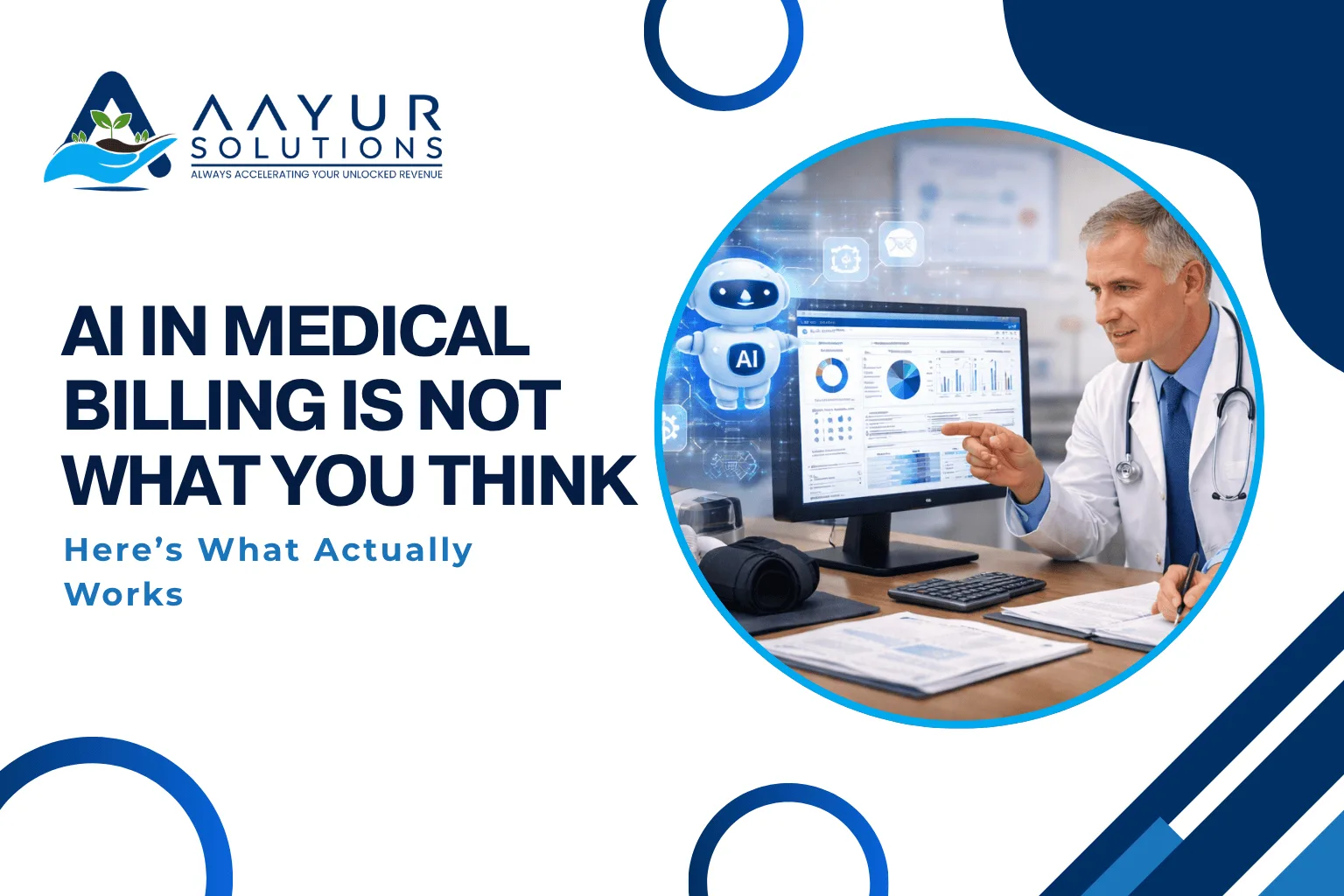
People think AI in medical billing is just robots taking over the whole job. But the fact is that’s not how it works. AI isn’t running the entire revenue cycle. Instead, it’s helping out in places where healthcare staff spend too much time and lose money: like charge capture, coding, eligibility checks, denial prevention, claim scrubbing, payment posting, and follow-up work.
What is AI in medical billing?
AI in medical billing refers to the use of intelligent systems to improve coding accuracy, reduce claim denials, and streamline processes like eligibility verification, claim scrubbing, and accounts receivable follow-up within medical billing and management services.
What actually works is not automation. It is focused, accurate intelligence that helps billing teams do their jobs faster and with fewer mistakes.
Why does that matter? Because billing errors cost a lot. In the US, the CFPB estimated $88 billion in medical bills appeared on credit reports, which tells you just how big billing issues are for both patients and providers.
On top of that, healthcare administrative waste remains a huge cost burden across healthcare.
As hospitals, clinics, and diagnostic centres grow, clean billing operations are no longer optional. Clean operations become essential. This is where medical billing and management services supported by AI help create structured, accurate, and scalable revenue cycle processes.
So, what does AI actually do in medical billing?
AI works best when it handles boring, repetitive, mistake-prone tasks, while experts keep making the calls that need real judgment.
Here’s where AI actually helps:
1) It catches billing mistakes before claims go out
Most revenue leakage happens before a claim ever hits the payer. Mixed-up modifiers, wrong diagnosis codes, missing patient details, or outdated insurance rules; all of these lead to denials. AI-powered claim scrubbing tools scan everything before submission and flag problems in real time, so teams fix mistakes before they turn into rejections.
This is one of the most impactful areas in medical billing and management services, because preventing errors before submission directly reduces denials and rework.
2) It supports faster and cleaner coding
Coding is tricky. AI can review through physician notes, spot likely ICD and CPT codes, and suggest options based on what’s actually written. Not guesswork, but pattern recognition based on clinical documentation and historical coding data.
It doesn’t replace certified coders. It just reduces a lot of grunt work, so coders spend less time hunting for code and repetitive review.
This matters because coding systems such as ICD-10-CM are detailed and regularly updated. AI makes coding accurate by handling this continuous operational challenge.
3) It predicts which claims are likely to be denied
This is where AI really pulls its weight. By looking at past submissions, payer habits, missing authorizations, and denial history, it can warn teams ahead of time which claims are at risk.
That gives people a chance to double-check documents, get the paperwork right, or update coding before they hit “submit.” In simple words, AI helps billing teams figure out,
“Will this claim actually get paid if we file it today?”
That’s way smarter than just pushing more claims through faster.
What actually improves collections?
Not every billing problem starts with coding. A lot of problems start way earlier in the process.
Instead of increasing claim volume, this approach improves claim quality, which is what actually drives reimbursements.
4) It automates eligibility and insurance verification
One of the biggest reasons claims get denied or delayed is incorrect insurance or eligibility data. If a patient’s plan isn’t active, has limited coverage, or you’re missing prior authorization, you get stuck in a loop of delays.
AI-powered verification tools jump in here. They pull up payer details, catch policy mismatches, and flag problems for your team before you even deliver care or send the bill. MGMA lists eligibility verification as a top revenue cycle best practice, and they’re right.
For Indian providers, whether you’re dealing with TPAs, insurers, or corporate panels, the same rule holds: check eligibility early, bill accurately, and skip the endless back-and-forth.
5) It improves payment posting and follow-up prioritization
AI isn’t just for the front end. On the back end, it changes how teams chase payments.
Rather than slogging through each unpaid account one by one AI can sort outstanding claims by probability of recovery, payer response behavior, claim age, denial codes, and risk factors. It pushes the accounts requiring urgent action to the front of the line.
This makes it easier for AR teams to catch accounts that need follow-up, streamlines cash flow, and cuts down on missed collections. That’s why advanced medical billing and management services make a measurable difference because collections improve when follow-up becomes structured.
What AI still cannot do well on its own
AI is handy, but it still needs humans watching over it.
It has trouble when:
• Provider notes are missing or unclear
• Payer policies change overnight
• Documentation doesn’t back up the claims
• Claims need strong appeal logic and nuanced judgment
• Interpreting compliance gets tricky
That is why “fully automated billing” is more marketing hype than reality. The smarter way? Combine AI-assisted billing with expert review.
What happens when billing processes lack structure
When billing is unstructured, problems don’t stay small they compound:
• AR continues to age beyond 90+ days
• Denials repeat without clear resolution
• Teams stay busy, but collections don’t improve
• Revenue leakage becomes harder to identify
In most cases, the issue is not effort it’s lack of visibility and process control.
What should healthcare providers actually implement?
If you’re thinking about AI for billing, don’t ask, “Can AI run our billing?” That’s missing the point.
Ask questions like:
• Does it cut down on front-end data mistakes?
• Can it boost coding accuracy?
• Will it help flag denial risks early?
• Can it speed up collections for my team?
• Does it fit smoothly into our HIS, PMS, or EHR workflows?
That’s where you get real value, not just flashy tech.
The goal is not full automation. The goal is control, visibility, and consistency across your revenue cycle.
What a strong billing setup looks like nowadays:
• Automated eligibility checks
• AI-assisted coding support
• Claim scrubbing before submission
• Denial prediction workflows
• Automated payment posting
• Human-led AR and denial management
That is the practical future of medical billing and management services structured systems supported by targeted AI and expert oversight.
The bottom line
AI in medical billing isn’t magic, and it’s definitely not a plug-and-play shortcut. What actually makes a difference is using targeted automation: fewer errors, faster coding, fewer denials, and faster revenue recovery. If you’re serious about stronger finances (without sacrificing accuracy), skip the hype.
Build a billing process that’s disciplined, efficient, and scalable.
Want to simplify billing, cut down claim denials, and boost your revenue? Aayur Solutions brings expert-driven medical billing and management services to help healthcare providers.
If your AR isn’t improving, the problem usually isn’t effort; it’s visibility.
At Aayur Solutions, we help healthcare providers identify where revenue is getting stuck across their billing process from front-end errors to AR follow-up gaps.
See what’s stuck in your AR.
Fix the process. Improve collections.
AI can support billing workflows, but it cannot replace the specialty-specific judgment that complex claims require. Aayur Solutions combines trained billing specialists with modern RCM technology to reduce denials and recover AR, without overpromising what automation alone can deliver.

Written by
Umesh Kushwaha Operations Manager, Aayur Solutions LLCUmesh Kushwaha is the Operations Manager at Aayur Solutions, running day-to-day delivery across medical coding, AR follow-up and denial management teams for DME, dental and pain management practices.
Connect on LinkedIn