
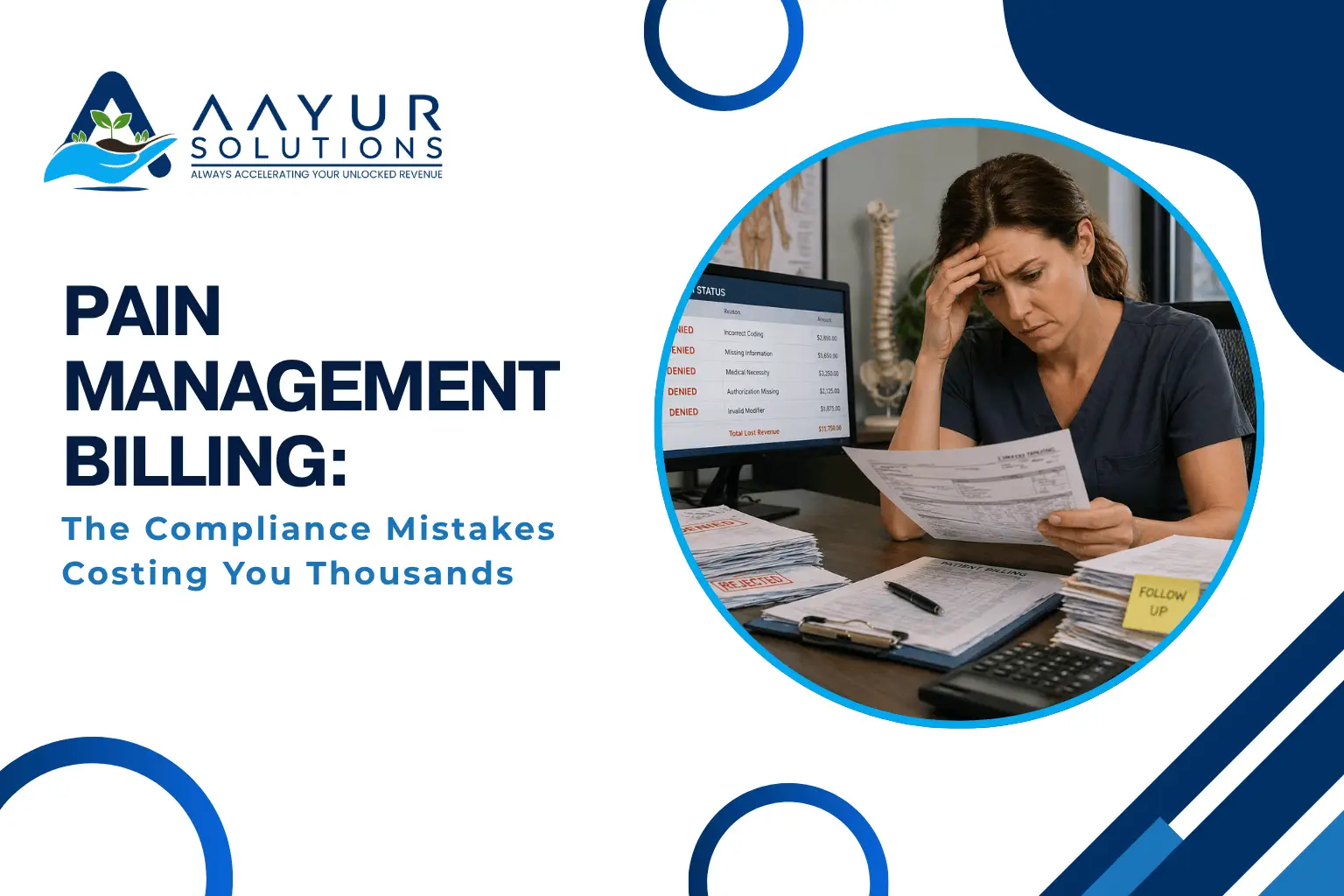
Pain management billing compliance sits at the intersection of clinical complexity and administrative risk. Procedure-specific documentation requirements, imaging guidelines, modifier rules, and payer-by-payer variations create more places for a claim to fail than in almost any other specialty.
The practices that struggle most aren’t cutting corners. They’re working hard but losing revenue quietly through compliance gaps that are easy to miss and expensive to ignore. This is exactly where a structured pain management billing service earns its value. If you are weighing providers, see our honest breakdown of the best pain management billing companies, competitors included.
If your practice keeps working hard but the numbers aren’t improving, the issue is rarely effort. The real problem hides in billing: compliance mistakes hidden inside your billing process.
Let’s talk straight about why pain practices lose thousands every year and how a structured pain management billing services can fix it.
1. The biggest revenue leak: weak documentation
You can do everything right in the procedure and still end up without payment. Why? Payers don’t evaluate intent. They only look at the documentation. In pain management, your notes need to spell out the patient’s actual condition, what treatments have already been tried, why this procedure makes sense right now, and all the exact technical details.
Audits show this is where things fall apart. Industry audit data and AMA coding guidance consistently show that incomplete or unclear documentation is a leading driver of specialty care denials, with some estimates placing it as the root cause in over 40% of cases. A brief note like “chronic back pain treated with injection” won’t be enough. You’ve got to list the level, side, imaging details, and why you chose this approach.
A reliable pain management billing service ensures documentation matches coding rules and payer expectations before claims go out. That’s how you actually get paid for the work you do.
2. Modifier misuse is silently killing approvals.
Pain procedures are tricky: bilateral injections, multiple sites, and imaging; all those details matter. Modifiers such as -50, -59, -LT, and -RT are critical to communicate this correctly.
But here’s the problem:
- Missing modifiers lead to underpayment or denials.
- Incorrect modifiers trigger audits or rejections.
For example, modifier -59 is frequently misused. It should only be applied when procedures are truly separate and not bundled. Either way, you’re at risk.
This is precisely where specialty-focused pain management billing services make a measurable difference. General billing teams process across many specialties and rarely develop the procedure-level familiarity needed to apply pain management modifiers correctly and consistently. A team that works specifically in pain management understands the context behind each modifier, not just the rule, but when it applies and when it doesn’t. But a pain management billing specialty-focused team applies modifiers correctly based on procedure context.
3. Coding errors go beyond “wrong code.”
Coding mistakes in pain management are rarely just “wrong code.” They’re more complicated than that. They usually involve:
- Unbundling procedures that should be billed together
- Upcoding to higher complexity levels
- Mismatch between diagnosis and procedure
- Lack of specificity in ICD codes
Here’s the real cost: Industry estimates suggest that improper coding leads 40% of claims getting denied in some specialty practices, and you can easily lose $25,000 or more every year because of it.
You can’t just solve this by hiring smarter coders. You need up-to-date coding knowledge, payer-specific rule checks, and a solid validation process before you send those claims out. A dedicated pain management billing service is built specifically to keep these problems out of your workflow through up-to-date coding knowledge, payer-specific rule validation, and a structured process that catches errors before claims go out, not after they come back denied.
If your practice is losing revenue to documentation gaps, modifier errors, or unworked denials, Aayur Solutions can help. Our pain management billing service covers the full revenue cycle from charge capture and coding through denial management and appeals so your team can stay focused on patient care while we focus on protecting your collections
4. Payer rules are changing faster than you think
Payer rules are changing faster than you realize. Outdated knowledge is one of the most underestimated risks in management billing.
You have to deal with Local Coverage Determinations (LCDs), National Correct Coding Initiative (NCCI) edits, and different rules for every insurance company. For example, some payers won’t pay for more than a certain number of facet joint injections within a time frame. Exceeding that, even with correct coding, can result in denial.
A common mistake is applying Medicare’s rules uniformly across all payers. Commercial insurers, managed care plans, and Medicare Advantage products each maintain their own coverage policies, frequency limitations, and documentation requirements. Assuming one rule set applies everywhere is one of the most consistent sources of preventable denials in pain management practices. Staying current requires active monitoring, not a one-time policy review, but ongoing updates built into your billing process.
5. Prior authorization gaps = immediate revenue loss
Pain management comes with its own headaches, especially when it comes to prior authorizations. It’s easy to run into problems like:
- authorization not obtained
- expired approval
- mismatch between authorized and billed procedure
- missing reference on the claim
And honestly, once you hit these snags, there’s not much hope. In many cases, the revenue is lost completely.
This is especially risky for expensive procedures like nerve blocks or radiofrequency ablations. That’s why you need automated tracking and alerts in place. Relying on people to catch these follow-ups is not reliable.
Fixing prior authorization gaps requires more than reminders and manual checklists. Effective pain management billing services use systematic tracking flagging procedures that require authorization before scheduling, monitoring approval expiry dates, and cross-referencing authorized procedures against what gets billed. When these checks are built into the workflow rather than left to individual follow-up, authorization-related denials drop significantly. For high-cost procedures like radiofrequency ablation or spinal cord stimulation, that protection is not optional; it’s essential.
6. Denials are not being followed up properly
Here’s a harsh reality.
Industry estimates suggest that nearly half of all denied claims are never appealed or reworked; they simply age out and become permanent bad debt. That’s not a billing problem. That’s a revenue strategy problem. That’s like giving up on half your lost money without even trying.
Usually, it’s because there’s no dedicated team for denials, appeals are not prioritized, or root causes are not tracked
A proper denial management workflow does not just resubmit claims. It figures out the patterns and stops repeat mistakes. This is a core function of any effective pain management billing service.
The bottom line
Pain management billing is inherently complex, but you’re not doomed to lose money. Most revenue loss traces back to compliance issues; you can prevent gaps in documentation, missing modifiers, rules nobody’s updated, or missed pre-authorizations.
Fixing these requires more than effort. It requires the right process and expertise.
If you want dependable pain management billing services, Aayur Solutions can help. We handle everything from start to finish. With our comprehensive medical billing management services, you see fewer denials, better compliance, and higher reimbursements for your specialty practice.

Written by
Umesh Kushwaha Operations Manager, Aayur Solutions LLCUmesh Kushwaha is the Operations Manager at Aayur Solutions, running day-to-day delivery across medical coding, AR follow-up and denial management teams for DME, dental and pain management practices.
Connect on LinkedIn